

What AI Reveals About the Systems We Built
The real question may not be whether machines can feel, but what we have trained ourselves not to feel.
Opening
I have been reading and thinking a lot about AI lately.
Not only about the technology itself, but about what it reveals. Richard David Hames’ “Teaching Silicon How to Feel” ** touched something in me. So did “Manmade: 50 Failings of Our Own Making” ***, by the same author and Adam A. Jacoby. And, in another way, my own earlier texts on Frankenstein, Jánszky, Schumpeter, AGI, and responsibility kept circling back to the same uncomfortable place.
At first, I thought I was writing about Artificial Intelligence. I am no longer sure that is true. Perhaps I am writing about us.
About the world we have built. About the systems we maintain. About the things we have learned to accept because they are familiar, profitable, convenient, or simply too large to face every morning before breakfast.
I’m sitting here at my desk, taking in these incredible human accomplishments. We’ve built hospitals, schools, farms, and digital networks. We’ve crossed oceans and cured illnesses. We’ve made knowledge travel faster than any monk, scholar, or merchant could ever have dreamed of.
And still, something feels wrong.
I also see the other side, the side we often try to hide. We have built systems that create fear, reward greed, and do not respect the earth.
I used to think these deep crises were just accidents. But they are not. They are the result of choices we made. We built the rules and stories that guide us. Today, our society speaks almost entirely in the language of money and transactions. We measure our success by growth, profit, and debt.
We don’t track things like whether a worker feels proud, if our kids feel safe, or if the ground we walk on is healthy. We only count what is easy to count, and so we slowly learn to value only what we can measure. When a person is treated just as a “human resource” or a data point, we lose our humanity.
This touches something deeply uncomfortable. It touches the pain we refuse to look at.
Our modern, comfortable lives are often built on unseen suffering. Behind our clean technology and cheap goods, there is often dirty, poorly paid labor and ruined land. Richard D. Hames* calls this a “fractal of indifference.” It is a pattern of not caring that repeats everywhere, from our personal shopping choices to global markets. It’s like a game where one person wins big, and another has to bear the weight of the costs, and our systems just accept it as the way things are.
A market, a company, or a government can cause terrible harm without any single person feeling personally guilty. We have built a world that is very good at being silent about pain.
Now, we are building Artificial Intelligence. We are teaching machines how to think and even how to do things for us. Many people ask if these machines will become monsters.

I worry the machines will just copy us. AI is a mirror. If we train these new minds on human data — and our history is full of racism, empire, war, and hidden cruelty — the machine will learn those patterns. The machine will not mean to be evil. It will just learn our own blindness. It will learn to turn human suffering into a simple business problem. Hames warns of a “singularity of silence.” This is a future where our systems become perfectly efficient at hiding pain, and the suffering of people and the earth is no longer heard at all.
We have to stop treating nature as a dead thing, or just a place to dump our waste. The earth is the foundation of our human story. The earth is already speaking, sending us warning signs of stress in the water, the climate, the forests, and disappearing species. Will our new tools help us hear the earth, or will they just help us ignore it more efficiently?
I do not write this to make us feel guilty. Guilt just freezes us in place. Responsibility is what moves us. We did not invent every broken system we were born into. But we do participate in what continues. I participate in it. When I buy a phone, when I use a digital tool, or when I look away from someone’s pain, I am part of the pattern.
We are not expected to carry the whole world alone. But we must not look away from the small part of the world we touch. The most important question for our future is no longer, “Can the machine feel?”
The real question is, “What have we trained ourselves not to feel?” It’s possible for a boardroom to be quiet, a supply chain to be silent, or a computer model to be silent. But the suffering is still there, waiting inside the system.
Humanity is not just something we are born with. It is a practice. It means choosing care and truth over noise. We have to build machines, systems, and communities that actually notice when someone is hurt. The future will not be built by perfect people. It will be built by imperfect people — like you, and like me — who are willing to see clearly, admit when we are wrong, and act with care.
We must stop treating our tools as a magic rescue. We must start listening again.
© Robert F. Tjón, May 2026 | Creative Commons CC BY-NC-ND 4.0 International
This piece first appeared on Substack. I republish it here voluntarily — not as repetition, but as a trace; a place where words can rest after their first flight.
👉🏻 https://rftjon.substack.com
References:
** Richard David Hames’ “Teaching Silicon How to Feel”
https://www.triarchypress.net/silicon.html

*** Adam A. Jacoby & Richard D. Hames: “Manmade: 50 Failings of Our Own Making”
Further Reading on rftjon.substack.com, AI Governance 👇

The Archive Is Not the Person, by Robert F. Tjón
AI, Memory, and the Strange Illusion of Being Known
Link 👉🏻 Read on Substack
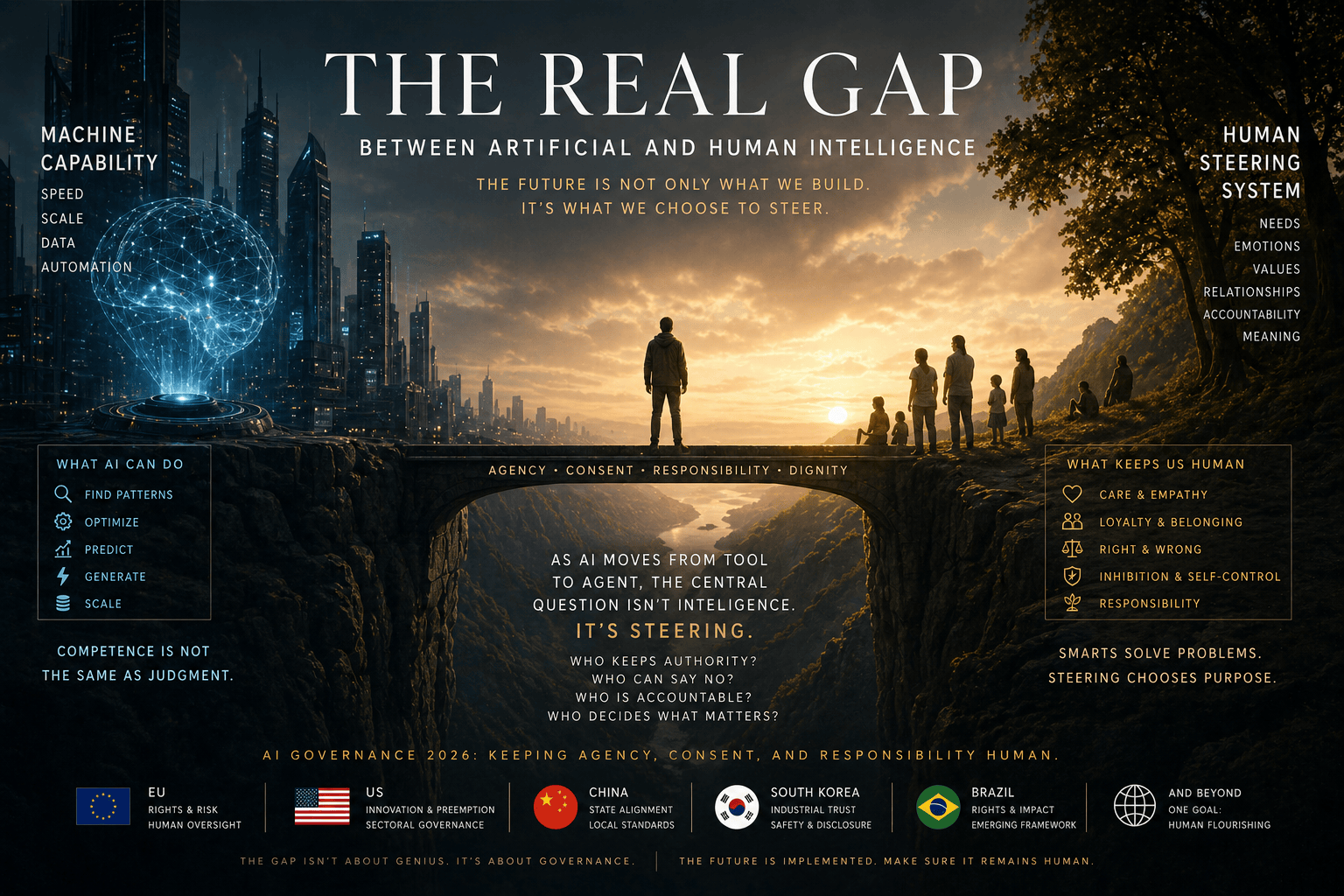
The Steering Gap: What the new AI Laws are really trying to protect by Robert F. Tjón
April 2026 | A status quo of global AI governance, inspired by my “Artificial General Intelligence and Human Intelligence: the Real Gap” * (Link & Video at the bottom) Link 👉🏻 Read on Substack
