A few weeks ago I was looking at a map of the world and realized how misleading maps can be.
The oceans look enormous. The routes look endless. The ships seem free to go almost anywhere. Yet more than 70% of the world’s trade by value, and over 80% by volume, depends on a handful of surprisingly narrow places.
A canal cut through a strip of desert. A strait between two coastlines. A passage so narrow that on a map it is almost invisible.
For all our talk about globalization, supply chains, artificial intelligence, and digital economies, the physical world still matters. Perhaps more than we like to admit.
Different places and different histories. But they share one characteristic: if something goes wrong there, people thousands of kilometers away eventually notice.
This communicates something important that the map alone cannot:
Hormuz is primarily an energy chokepoint.
The Taiwan Strait is primarily a technology and container chokepoint.
Malacca is the most diversified chokepoint.
Suez + Bab-el-Mandeb form a single strategic system.
Panama is less critical globally but highly important for specific North American and Latin American trade flows.
The Network behind the Numbers
These chokepoints are not independent. Think of them as a network.
When we think about the global economy, we tend to think about factories. Taiwanese semiconductors. German machinery. Chinese manufacturing. American technology.
But factories are only part of the story. What connects them matters just as much. One of the lessons of recent years is that a route does not need to be physically blocked to become unusable. Often the closure begins somewhere less visible: insurers raise premiums, shipping companies reroute vessels, and risk managers decide a passage is no longer worth the gamble.
The ships may still be moving and the waterway may technically remain open. Yet commerce has already started looking for another path. What struck me while researching these chokepoints is that they are not separate problems. They form a network.
Hormuz connects to Bab-el-Mandeb and Suez. Together they form a continuous energy and trade corridor. Taiwan feeds Malacca, a continuous manufacturing and semiconductor corridor. Panama increasingly serves as an overflow valve when Eurasian routes become stressed or disrupted.
Pressure in one part of the system does not disappear, it moves elsewhere. A disruption at one point does not merely reduce traffic there. It pushes pressure into the rest of the system. The result is often
longer shipping routes,
higher insurance premiums,
increased fuel consumption,
vessel shortages,
inventory delays,
and ultimately higher prices for consumers.
The longer I look at these maritime chokepoints, the more I find myself questioning the common assumption that globalization made geography less important.
The opposite may be true.
The world economy is not floating freely across the oceans. It is balanced on a surprisingly small number of narrow passages. Some of those passages are becoming increasingly fragile.
The next time a product arrives late, a fuel price jumps unexpectedly, or a factory slows production, the cause may not be found in a boardroom or a warehouse. It may begin in one of these narrow waterways, far beyond the horizon, where the global economy still passes single file.
Readers interested in the underlying data, sources, methodology, and detailed verification of the trade-flow estimates can access the full research dossier here:
With Video at the bottom of the original article. This piece first appeared on Substack.I republish it here voluntarily — not as repetition, but as a trace; a place where words can rest after their first flight.
AI Disclosure: My work utilizes artificial intelligence for data synthesis and structural mapping. Please note that AI-generated insights may occasionally contain inaccuracies; readers are encouraged to verify critical information. All conclusions and final editorial decisions remain the original work of Robert F. Tjón.
Europe still waits for war to announce itself. Russia has found the space where it does not have to.
Europe still has an old reflex.
War is what happens when tanks cross a border. Peace is what exists before that moment. Between the two, we imagine diplomacy, tension, espionage perhaps — but not war.
That distinction once made sense. It helped Europe rebuild itself after catastrophe. It gave us law, treaties, alliances, courts, procedures, and the comforting belief that violence would be visible before it became decisive.
But Russia has found the space between those categories. The grey zone: not peace, not open war either. Something colder.
A cyber intrusion that can be denied. A local-looking news site that did not grow locally. A railway cable cut at the wrong moment. A leaked conversation, twisted just enough to poison trust. A drone near sensitive airspace. A rumour released when an election is already tense.
Each incident remains small enough to be argued about. The argument is part of the method. Taken together, they create pressure. Pressure, applied long enough, changes political reality.
The old European reflex
Europe’s success has also left it with a blind spot.
The continent was rebuilt around the idea that conflict could be contained by law, trade, institutions, treaties, and procedures. This was not naïve. It was one of the great achievements after 1945.
But every achievement has a shadow. Europe became very good at managing peace. It became less fluent in recognizing hostility that does not arrive in the old forms.
A missile is easy to classify. A tank column forces the language to become clear. An invasion removes ambiguity.
But what do we call a slow campaign of confusion? Sabotage that cannot be attributed immediately? The deliberate amplification of mistrust and exhaustion?
Too often, we reach for smaller words. Interference. Disinformation. Cyber activity. Incident. These words are not false. They describe the tools. They do not yet describe the strategy.
Russia’s method is not necessarily to defeat Europe in a direct military confrontation. That would be costly, risky, and uncertain. A cheaper method is to make Europe less sure of itself: less sure of its governments, its media, its elections, its alliances, its support for Ukraine, and sometimes even of the future it claims to defend.
That is why the grey zone matters. It is not a place on a map. It is the condition in which a democracy is attacked before it has agreed on the name of the attack.
The grey zone
The grey zone works because it exploits the better instincts of open societies.
Democracies hesitate before naming guilt and asks for evidence. They argue over proportionality and worry about escalation. They distinguish criticism from manipulation. Europe asks whether a response might injure the freedoms it wants to protect.
Open societies should do all that, the hesitation is not weakness; it is part of our civilization.
It becomes dangerous when the other side understands this hesitation better than we do.
A hostile actor does not need every operation to succeed. Enough noise, doubt, and delay will do. One false story is corrected, while another has already moved. One cyberattack is denied. One sabotage case is treated as isolated. A leak becomes a scandal before its context catches up.
Then the democratic system does much of the work itself. Journalists investigate. Politicians accuse each other. Citizens divide into camps. Institutions speak carefully, sometimes too carefully. Social media rewards the sharpest emotion, not the soundest judgment.
By the time the facts become clearer, the emotional damage is already done.
That is the advantage: cheap, deniable, and cumulative. Europe is kept in a state of interpretive delay. Not quite enough to respond, but never small enough to ignore.
The real target
We still speak of critical infrastructure as if it were mainly physical: ports, railways, power grids, pipelines, airports, data centres, satellites, undersea cables, hospitals, food chains, government servers.
A modern society is a fragile choreography of systems most citizens never see until they fail. Below that physical layer lies another kind of infrastructure: trust.
Not blind, not the childish belief that governments, media, or institutions are always right. Something more modest and more necessary: the minimum trust without which a society cannot function.
Trust that elections are not theatre and that facts still matter. Trust that disagreement is not treason and imperfect institutions are not automatically illegitimate. Trust that a political opponent is not necessarily an enemy of the people. Trust that reality exists outside the emotional machinery of the feed.
This is the layer being tested.
Russia did not invent Europe’s distrust. Europe has enough of its own failures, arrogance, bureaucracy, inequality, hypocrisy, and political blindness. No foreign power is needed to explain why citizens sometimes lose faith.
But external pressure can find the crack and widen it. That is the essence of hybrid conflict. It studies the weakness, feeds it, amplifies it, and waits for the target society to turn against itself.
A lie is not always meant to be believed, but it may be enough to make truth feel unreachable. A rumour is not always meant to persuade; it only needs to make people tired. A scandal is not always meant to reveal; sometimes it is enough that public life or politics begins to look dirty.
The target is therefore not only what Europe has; it is what Europe still believes about itself.
This is why democracy itself has become critical infrastructure. I do not mean that as a slogan. From a practical point of view:
If a railway line is damaged, goods cannot be transported. When a power grid is disrupted, homes and factories cease operations. When a hospital system is attacked, lives are endangered. If public trust erodes, democratic decisions lose their legitimacy and the political centre slowly melts.
A democracy cannot survive only on rules. It also needs habits: checking before sharing, tolerating uncertainty, accepting electoral defeat, listening without surrendering judgment, and asking who benefits when anger becomes too perfectly targeted.
These habits do not look like defence policy. But they are part of defence now.
That is uncomfortable because we would prefer European defence to be about armies, intelligence services, cyber agencies, and ministers. They have their part, a large one, and certainly a larger one than now. But they cannot protect the civic nervous system alone.
Citizens are no longer outside the security perimeter.
This does not mean every citizen must become suspicious or obedient. Quite the opposite. A frightened society is easy to manipulate, and a cynical society is easy to exhaust. When we see enemies everywhere, we may damage ourselves more efficiently than any foreign power could.
The task is harder: to stay open without being naïve, critical without becoming corrosive, free without being defenceless.
The danger of overreaction
There is a trap here.
Once we say that democracy is under attack, some will be tempted to treat dissent itself as suspicious. That would be a mistake. A dangerous one.
Not every anti-NATO voice is a Russian asset, and not every criticism of Ukraine policy is propaganda. Furthermore, not every angry citizen has been manipulated, and not every unpopular question is subversion.
A democracy that forgets this begins to defend itself by narrowing itself. The media may mirror that, perhaps even enforce it. That would be another form of defeat.
The solution to manipulation cannot be a fragile public discourse that only tolerates approved opinions. The answer to disinformation cannot be to infantilize citizens or resort to outright lies. The solution to foreign interference cannot be to prioritize secrecy whenever honesty would be challenging.
If trust is infrastructure, governments also have obligations. They must speak clearly, have the courage to admit uncertainty when it exists, avoid exaggeration, and resist the temptation to use security language as a shield against political accountability. Above all, they must earn enough trust to ask for vigilance. Without trust, citizens feel offended and turn to extremists.
Citizens are not stupid; they know when language is being managed. People feel when institutions speak more to protect themselves than to inform the public.
And that, too, creates openings for hostile actors and extremists.
The defence of democracy begins at home. Not in the sentimental sense. In the practical sense.
A state that wants citizens to resist manipulation must not manipulate them itself.
The sober answer
So what does resilience look like?
Don’t panic, and don’t expect a permanent emergency. It’s not the militarization of public life, nor is it a Europe where every uncomfortable opinion is scrutinized for foreign influence. Resilience is quieter than that.
It is the discipline of naming hostile acts when the evidence is strong, protecting infrastructure before disaster makes it fashionable, teaching critical media literacy without naivety or condescension, building cyber defense without theatre, and practicing political leadership that does not feed the same mistrust it claims to fight. It also means learning, as citizens, to pause before passing on the emotional spark.
Resilience is sober adulthood.
Europe has sometimes behaved as if peace were a natural condition, interrupted only by war. But peace is not a default setting; it is a structure. It needs maintenance and memory. It requires institutions that still deserve confidence and citizens who do not confuse freedom with carelessness.
Russia’s grey-zone pressure forces Europe to rediscover this. Not because Russia is all-powerful, but because the battlefield has widened.
Some of it is still military. Some of it is cyber. Some of it runs through ports, cables, satellites, and energy systems. But some of it runs through the ordinary mind of the citizen: what we believe, what we doubt, what we forward, what we forgive, what we stop caring about.
That is the uncomfortable part.
Europe still waits for war to look like war. Russia has learned to arrive otherwise.
If democracy is now critical infrastructure, then defending it cannot mean simply guarding buildings, servers, and borders. It must also mean repairing the common space in which citizens decide what is real, what is worth defending, and what kind of society they refuse to become.
Not perfect. Not innocent. Not always wise. But still worth defending.
Note
This essay is not about panic. It is about the uncomfortable fact that modern pressure on Europe often happens below the threshold of open war. The target is no longer only territory or infrastructure. It is democratic confidence itself.
This piece first appeared on Substack.I republish it here voluntarily — not as repetition, but as a trace; a place where words can rest after their first flight.
The real question may not be whether machines can feel, but what we have trained ourselves not to feel.
Opening
I have been reading and thinking a lot about AI lately.
Not only about the technology itself, but about what it reveals. Richard David Hames’ “Teaching Silicon How to Feel” ** touched something in me. So did “Manmade: 50 Failings of Our Own Making” ***, by the same author and Adam A. Jacoby. And, in another way, my own earlier texts on Frankenstein, Jánszky, Schumpeter, AGI, and responsibility kept circling back to the same uncomfortable place.
At first, I thought I was writing about Artificial Intelligence. I am no longer sure that is true. Perhaps I am writing about us.
About the world we have built. About the systems we maintain. About the things we have learned to accept because they are familiar, profitable, convenient, or simply too large to face every morning before breakfast.
I’m sitting here at my desk, taking in these incredible human accomplishments. We’ve built hospitals, schools, farms, and digital networks. We’ve crossed oceans and cured illnesses. We’ve made knowledge travel faster than any monk, scholar, or merchant could ever have dreamed of.
And still, something feels wrong.
I also see the other side, the side we often try to hide. We have built systems that create fear, reward greed, and do not respect the earth.
I used to think these deep crises were just accidents. But they are not. They are the result of choices we made. We built the rules and stories that guide us. Today, our society speaks almost entirely in the language of money and transactions. We measure our success by growth, profit, and debt.
We don’t track things like whether a worker feels proud, if our kids feel safe, or if the ground we walk on is healthy. We only count what is easy to count, and so we slowly learn to value only what we can measure. When a person is treated just as a “human resource” or a data point, we lose our humanity.
This touches something deeply uncomfortable. It touches the pain we refuse to look at.
Our modern, comfortable lives are often built on unseen suffering. Behind our clean technology and cheap goods, there is often dirty, poorly paid labor and ruined land. Richard D. Hames* calls this a “fractal of indifference.” It is a pattern of not caring that repeats everywhere, from our personal shopping choices to global markets. It’s like a game where one person wins big, and another has to bear the weight of the costs, and our systems just accept it as the way things are.
A market, a company, or a government can cause terrible harm without any single person feeling personally guilty. We have built a world that is very good at being silent about pain.
Now, we are building Artificial Intelligence. We are teaching machines how to think and even how to do things for us. Many people ask if these machines will become monsters.
I worry the machines will just copy us. AI is a mirror. If we train these new minds on human data — and our history is full of racism, empire, war, and hidden cruelty — the machine will learn those patterns. The machine will not mean to be evil. It will just learn our own blindness. It will learn to turn human suffering into a simple business problem. Hames warns of a “singularity of silence.” This is a future where our systems become perfectly efficient at hiding pain, and the suffering of people and the earth is no longer heard at all.
We have to stop treating nature as a dead thing, or just a place to dump our waste. The earth is the foundation of our human story. The earth is already speaking, sending us warning signs of stress in the water, the climate, the forests, and disappearing species. Will our new tools help us hear the earth, or will they just help us ignore it more efficiently?
I do not write this to make us feel guilty. Guilt just freezes us in place. Responsibility is what moves us. We did not invent every broken system we were born into. But we do participate in what continues. I participate in it. When I buy a phone, when I use a digital tool, or when I look away from someone’s pain, I am part of the pattern.
We are not expected to carry the whole world alone. But we must not look away from the small part of the world we touch. The most important question for our future is no longer, “Can the machine feel?”
The real question is, “What have we trained ourselves not to feel?” It’s possible for a boardroom to be quiet, a supply chain to be silent, or a computer model to be silent. But the suffering is still there, waiting inside the system.
Humanity is not just something we are born with. It is a practice. It means choosing care and truth over noise. We have to build machines, systems, and communities that actually notice when someone is hurt. The future will not be built by perfect people. It will be built by imperfect people — like you, and like me — who are willing to see clearly, admit when we are wrong, and act with care.
We must stop treating our tools as a magic rescue. We must start listening again.
This piece first appeared on Substack.I republish it here voluntarily — not as repetition, but as a trace; a place where words can rest after their first flight.
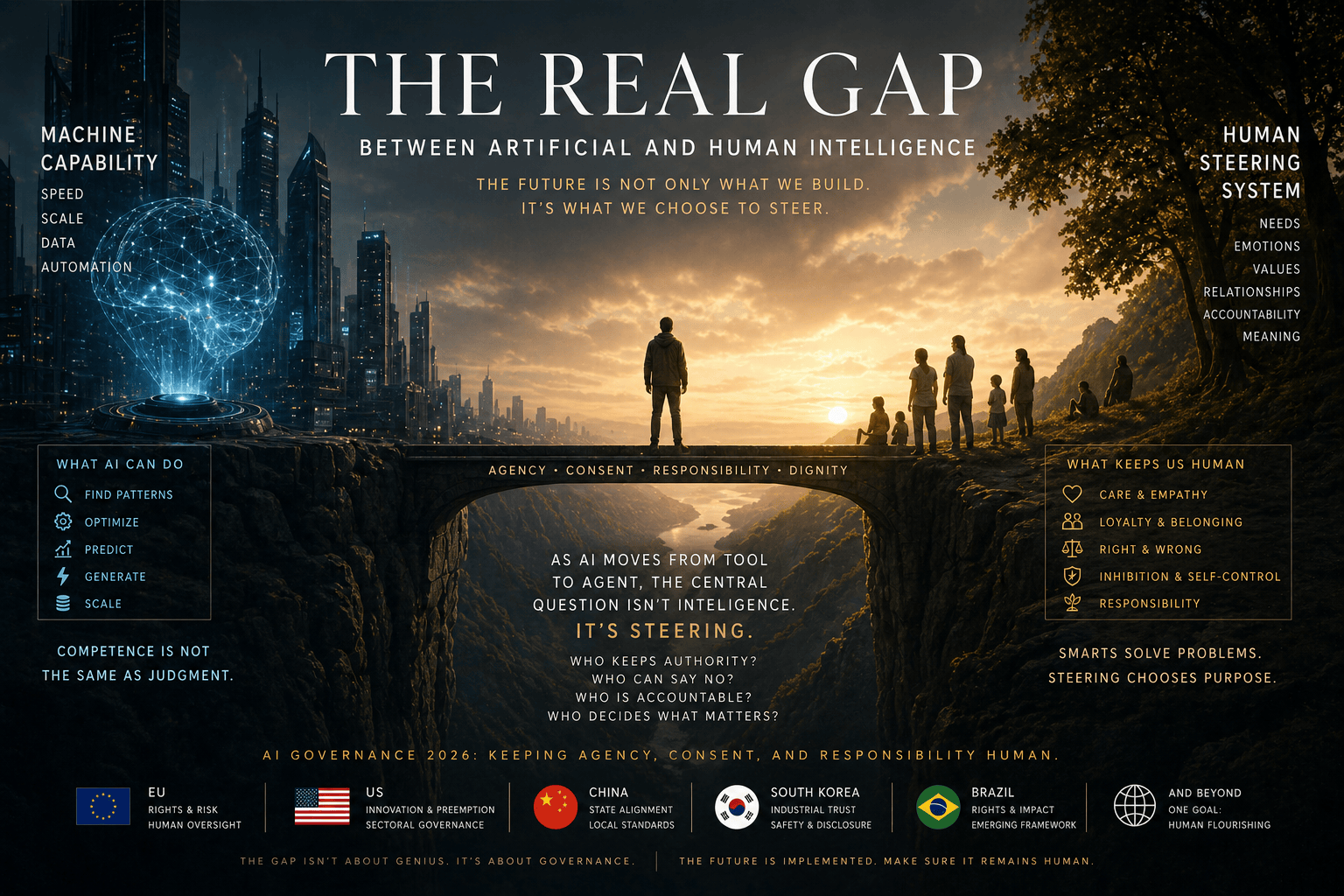
The Steering Gap: What the new AI Laws are really trying to protect by Robert F. Tjón
April 2026 | A status quo of global AI governance, inspired by my “Artificial General Intelligence and Human Intelligence: the Real Gap” * (Link & Video at the bottom) Link 👉🏻 Read on Substack
Why one Silicon Valley billionaire now frames the future in openly apocalyptic terms (Video at the bottom)
Paris, Monday, January 26, 2026. A closed room. Peter Thiel at the Academy of Moral and Political Sciences. A tech billionaire no longer speaking about startups, but about the Antichrist. How did we get from PayPal and monopoly theory to this?
The question matters not only because the billionaire is Peter Thiel. It matters because his language seems to mark a wider shift in the culture that produced him. For years, Thiel was known as one of Silicon Valley’s sharpest contrarians: the man of Zero to One, monopoly theory, startup ambition, and deep skepticism toward competition. He argued that progress comes from building what does not yet exist, not from copying what already works. He attacked imitation, praised originality, and treated stagnation as one of the deepest problems of modern society.
That older Thiel was already unusual. He did not speak like a normal CEO. He mixed business with philosophy, technology with grand historical claims, and investment thinking with a deeper suspicion of democratic habits. But in recent years, something in his public language has changed.
The shift is not total.
The old themes are still there. He still worries about stagnation. He still distrusts bureaucracy. He still prefers founders to committees, invention to regulation, and decisive people to managerial systems. Yet since 2022, the tone has grown darker, more religious, and more openly civilizational. The vocabulary of startups has not disappeared, but it is now joined by a second vocabulary: apocalypse, Antichrist, salvation, world order, and fear.
This is what makes Thiel interesting today. He is no longer just a billionaire with eccentric ideas. He has become a signal. He tells us something about the changing inner language of part of the Western elite: a language in which technology, faith, decline, sovereignty, and fear now speak to one another.
To understand that shift, it helps to begin with the older foundations of his worldview. Only then does the more recent turn toward emergency, prophecy, and political theology become fully visible.
At the center of his thinking lies a simple rebellion against the ordinary way modern societies talk about markets and progress. He rejects the idea that competition is healthy in itself. In his view, competition often destroys profits, forces companies into imitation, and traps them in short-term struggle. The goal is not to compete better. The goal is to build something so distinctive that competition becomes almost irrelevant. That is the core of his famous idea of going from zero to one: creating something genuinely new rather than multiplying what already exists. Lamps were not created by merely improving candles.
He pairs that with another long-running argument: the West has not progressed as much as it thinks. We have seen real breakthroughs in the world of software, computing, and digital communication, but far less in the physical world of energy, transport, medicine, and infrastructure. In other words, we became brilliant with “bits” while falling behind with “atoms.” This belief in stagnation has shaped much of his public message for years. Modern societies, in his view, are not boldly building the future. They are managing slowdown and calling it wisdom.
There is also a deeper philosophical layer.
Thiel was shaped by René Girard, the French thinker who argued that human beings often want things because others want them first. Desire is imitative. Rivalry grows from imitation. Violence follows. This Girardian influence helps explain why he distrusts mass psychology, crowd behavior, and social competition. It also helps explain why he often sounds less like a business strategist than like a student of imitation, power, and hidden conflict.
Even before the recent religious turn, there was already something larger in his outlook: a sense that modern systems are fragile, imitative, and unable to tell the truth about themselves. That older foundation matters because the newer Thiel did not appear out of nowhere. The apocalyptic language came later, but the distrust of imitation, weakness, and managed decline was already there.
Since 2022, however, this older framework seems to have moved into a more openly political and religious phase.
The first step in that shift was a broadening of the stagnation thesis. Thiel no longer spoke only about weak innovation or slow growth. He began to describe Western societies as trapped in a larger mood: aging, cautious, overregulated, unable to build, unable to believe, and too ready to let fear decide the limits of action.
In this reading, institutions no longer guide a confident civilization. They manage decline while calling it responsibility. What once sounded like a criticism of innovation policy starts to sound more like a diagnosis of civilizational fatigue. From there, the argument grows sharper. Once stagnation is no longer just economic but civilizational, the next question becomes obvious: who benefits from a society trained to fear risk more than decline?
The second step was his growing suspicion of what might be called emergency politics. Here the argument becomes sharper. Thiel does not deny that certain risks are real. Nuclear war is real. Artificial intelligence may be dangerous. Bioweapons are dangerous. Climate risks are serious.
But he increasingly warns that fear of these dangers can itself become the mechanism of a new kind of control. The danger is no longer only the catastrophe itself. The danger is the political order that claims it must save us from catastrophe at any price. That is the hinge on which his later worldview turns. And once that hinge is in place, his more openly religious language begins to make sense.
At some point, fear stops being a policy concern and becomes a governing style. Politics is no longer about persuasion, limits, and trade-offs. It becomes a permanent language of prevention. Every crisis is global. Every problem is existential. Every response must be centralized, coordinated, and urgent. Once that happens, freedom begins to look like irresponsibility. Dissent starts to look like danger. And the promise of safety becomes a moral weapon.
This appears to be the space where Thiel now places the figure of the Antichrist.
Here we need to proceed carefully. We do not have a full public transcript of his Paris and Rome lectures. What exists is a mix of public interviews, reported summaries, and later accounts of related talks. So some claims belong to documented public statements, while others are careful reconstructions.
Still, the pattern is clear enough. Thiel seems increasingly drawn to the idea that the modern tyrant would not arrive with the old face of naked brutality. He would arrive promising peace, safety, and the prevention of disaster. He would not look like chaos. He would look like order. He would not openly worship destruction. He would speak the language of protection and “national security.”
This is why the formula “Armageddon or Antichrist” matters. It is not only rhetorical theater. It is a map of the future as he sees it. On one side stands collapse: war, technological catastrophe, uncontrolled violence, civilizational breakdown. On the other side stands a false solution: a one-world order built to prevent collapse through surveillance, control, and the freezing of dangerous freedom. In his framework, the real trap is that people may accept domination because it comes packaged as rescue.
At its strongest, this argument touches something real in modern life. We do live in an age where emergency language has become powerful. Governments, institutions, and corporations often justify extraordinary authority by appealing to extraordinary threats. Precaution can become expansive. Risk can become ideology. A public trained to fear may indeed become more willing to surrender judgment in exchange for management. Thiel is not imagining that temptation from nowhere.
But this is only half the picture. And that is where the article must pause before following him too far.
The other half is the question his critics raise: what happens when the fear of public domination becomes an excuse for private domination? What happens when the critique of bureaucracy becomes a justification for elite power without democratic restraint? What happens when the language of salvation is taken up not by states alone, but by wealthy technological actors who also believe they are uniquely fit to guide the future?
This is where the European and Catholic critiques become important, especially the work of Paolo Benanti. Benanti does not see Thiel as a curious investor who wandered into theology. He sees him as something more coherent and more troubling: a theological-political actor whose vision takes partial truths and turns them into absolutes. Competition, technology, sovereignty, the individual, and the fear of global control each contain a fragment of truth.
But once detached from balance, they can form a new and distorted doctrine. In Benanti’s reading, this is why the word “heresy” matters. Not because Thiel is simply secular or impious, but because he selects, intensifies, and reorganizes reality around chosen truths until they harden into a rival faith.
This critique should be neither accepted lazily nor dismissed too quickly. It is interpretive, not neutral. It tells us how an alert European religious thinker reads Thiel, not what he literally said line by line in Paris. Still, it helps clarify what is at stake. The struggle here is not only about politics in the narrow sense. It is also about who gets to define danger, who gets to speak in the name of the future, and what kind of moral language now organizes power.
That may be the deepest reason why Thiel’s recent turn matters.
He reveals a crossing of categories that many people still prefer to keep separate. Technology is no longer just about tools. Religion is no longer just about private belief. Politics is no longer just administration. They are converging, and in that convergence words like progress, survival, freedom, and salvation begin to overlap in strange ways.
Seen in this light, the question is no longer simply what Thiel believes. The question becomes why this kind of language now travels so easily between technology, politics, and religion.
Seen in this light, Thiel is neither simply a prophet nor simply a reactionary. He is better understood as a figure of transition. He carries old Silicon Valley confidence in elite builders and combines it with something darker: the feeling that the liberal world has lost its center, that managerial systems no longer inspire trust, and that only large civilizational stories can now explain what is happening.
His turn toward apocalyptic language may therefore say less about private eccentricity than about a larger exhaustion. When institutions lose legitimacy, prophecy returns.
There is, of course, a danger in that return. Apocalyptic language can illuminate hidden structures of fear and control. But it can also simplify the world too much. It can divide reality into final enemies and false saviors. It can tempt people to read every institution as deception and every limit as surrender. And once politics is framed in such total terms, compromise begins to look like betrayal.
That is why Peter Thiel should be read carefully, not casually.
He may be right that some forms of emergency governance carry a hidden hunger for permanent control. He may be right that fear can become a political technology. He may be right that stagnation has moral as well as economic causes. But he may also be giving us a new elite myth: a story in which concentrated private power appears courageous and liberating, while public restraint always appears weak, manipulative, or spiritually corrupt.
The real question, then, is not whether Peter Thiel has become more religious.
He clearly has, at least in public language. The deeper question is why this form of religious-political speech now seems plausible, even attractive, to parts of the technological elite. Why does a language once limited to theology or fringe prophecy now appear inside the mental world of investors, founders, and strategic power brokers?
Perhaps because the old language has run out. “Innovation” no longer explains enough. “Democracy” no longer inspires enough trust. “Governance” sounds managerial and thin. In such a moment, stronger words return. Judgment. Salvation. Collapse. Antichrist.
L’Académie des Sciences morales et politiques à l’Institut de France.
Paris. Closed room. The Academy of Moral and Political Sciences.A billionaire speaking about the Antichrist.
That scene feels strange. But perhaps it feels strange only because it arrived before we were ready to admit what kind of age we may be entering.
This piece first appeared on Substack.I republish it here voluntarily — not as repetition, but as a trace; a place where words can rest after their first flight.
AI, Memory, and the Strange Illusion of Being Known
Opening
Over the last months, I have been exporting pieces of my digital life: conversations with AI systems, publication lists, drafts, CSV files, JSON files, and fragments of old projects.
It is a strange experience. A little like packing boxes before moving house. You discover forgotten things. You find traces of yourself. But you also notice something uncomfortable: even when the archive is large, it is still not the person.
An archive can remember what was said, but it cannot know why it mattered. AI can help us retrieve, organize, and sharpen our memories. But an archive is still only a trace. It is not the life that made it.
The archive contains words, dates, drafts, corrections, metadata, even emotion in written form. But it does not contain the full weight of a moment: fatigue, hesitation, grief, pride, shame, love, or silence.
I. The new private archive
Many of us are now creating personal archives without fully realizing it.
Emails, notes, voice messages, photos, AI conversations, Substack and WordPress drafts, LinkedIn and Facebook posts, browser histories, exported files.
We used to think of an archive as something for historians, governments, churches, or companies. Now ordinary people also carry archives. They are just hidden in devices and cloud accounts.
AI changes the meaning of this. For the first time, these archives can talk back.
That is fascinating. It is also dangerous if we forget the difference between retrieval and understanding.
II. The seduction of being recognized
AI can create a powerful illusion: it seems to “know” us. It remembers tone, notices recurring themes, summarizes our projects, and imitates our style.
But being recognizable is not the same as being known.
A system may identify that I write about dignity, governance, Thailand, Europe, grief, responsibility, and technological change. That is useful. But it does not mean it knows the lived path behind those words.
It can see the pattern, but it cannot carry the wound. Its usefulness depends on proper boundaries.
III. The archive has no body
An archive has no body. It does not age, and it does not wake up at night. It does not feel the humidity in Isaan, the winter in Alsace, or the pressure in a boardroom before a difficult decision.
It contains traces of experience, but not the body that passed through it.
It cannot see through “two lenses”: my Western lens organizes, classifies, exports, and stores. My other lens, from my lived experience in rural Thailand, reminds me that memory also lives in gestures, places, rituals, voices, and absences.
The archive is vertical: folders, files, dates, categories. It is rational.
Memory is more horizontal: a smell, a face, a song, a field after rain, a sentence one cannot forget.
IV. The danger of polished reconstruction
AI does not only retrieve; it also smooths.
This is helpful when a text is confused. But it is dangerous when the roughness contains truth.
A polished sentence may be less honest than the imperfect one. A clean summary may remove the hesitation or doubt that mattered. A balanced paragraph may hide the moral discomfort that gave the text its force.
This is where the essay becomes a reflection on authorship. The question is not whether AI may assist. It may, and it already does. The question is whether the human author still recognizes himself in the result.
V. Co-creation without surrender
A good AI assistant can help find what was forgotten, structure what is scattered, translate without flattening, and challenge the author without replacing him. It should help the text breathe, not seal it under glass.
But it becomes dangerous when it begins to sound too complete, too certain, too smooth.
So the real question is: how can AI help without slowly taking over my voice?
Co-creation without surrender begins with a simple rule: the human author must remain the final witness. AI may suggest, compare, structure, translate, and challenge. But it has not lived the life behind the words. It has not sat in the room. It has not carried the silence after a difficult sentence. It has not paid the price of the decision.
That means I must stay awake while using it.
I have to know what I am asking for. Am I asking AI to correct grammar, make a paragraph clearer, test an argument, find repetitions, or translate without flattening? These are different tasks. If I ask vaguely, I should not be surprised when the answer moves too far away from me.
I also need to protect the rough places in a text. Not every uneven sentence is a mistake. Sometimes the hesitation is the truth. Sometimes the short sentence carries more weight than the elegant one. Sometimes a small imperfection is the place where the human being is still visible.
Then I must read the AI version against my own inner ear. Does this still sound like me? Would I say this in a conversation? Is the sentence clearer, or only more polished? Has the text become more precise, or merely more impressive?
These questions matter more than style.
AI should be a mirror, not a mask. A mirror can show me what I missed: repetition, weak structure, missing links, or an argument that does not yet stand. A mask is different. A mask begins to speak in my place.
That is where the danger lies. AI becomes useful when it helps me return to what I wanted to say. It becomes dangerous when it tempts me to accept fluency as truth.
So I need a few practical habits.
I should keep my original draft. I should compare versions. I should mark sentences that feel too perfect. I should ask AI to simplify before asking it to beautify. I should ask what it removed, not only what it added. And when a sentence feels emotionally important, I should decide myself.
This is not resistance to AI. It is responsible use.
VI. Closing
The archive is useful. The archive matters. Without it, many things disappear. But the person remains more than the archive.
I will continue to use AI. I will continue to build my archive. I will continue to ask machines to help me find, compare, translate, and structure.
But I do not want to confuse the box of letters with the life that wrote them.
The archive can help me remember, but it cannot remember for me.
Robert F. Tjón, June 2026
For deeper reading:
Marshall McLuhan, Understanding Media: The Extensions of Man (1964). McLuhan’s phrase “the medium is the message” is often used to describe how communication technologies reshape perception and social life, not merely transmit content.
Alfred Korzybski, Science and Sanity (1933). The phrase “the map is not the territory” points to the difference between a representation of reality and reality itself.
Andy Clark and David Chalmers, “The Extended Mind” (1998). Their argument suggests that tools such as notebooks, and by extension some digital systems, can become part of human cognitive processes.
“Lifelogging” refers to the practice of digitally recording aspects of daily life. It is often discussed in relation to wearable devices, personal data archives, and quantified-self practices.
Paul Ricoeur’s work on narrative identity is relevant here, especially the idea that personal identity is shaped through time, memory, and narrative reconstruction.
Legend
AI — Artificial Intelligence.
CSV — Comma-Separated Values, a table-like data file.
JSON — JavaScript Object Notation, a structured data format often used for exported conversations or archives.
This piece first appeared on Substack.I republish it here voluntarily — not as repetition, but as a trace; a place where words can rest after their first flight.
A status quo of global AI governance, inspired by my “Artificial General Intelligence and Human Intelligence: the Real Gap” * (Link & Video at the bottom)
Opening
Imagine a future AI assistant that does not only answer your questions. It books your doctor’s appointment, negotiates your insurance premium, selects the school materials for your child, drafts your work messages, monitors your sleep, and gently corrects your mood when you are becoming ‘unproductive.’
At first, it feels like help. Then it becomes convenience. Then it becomes default. And finally, refusal starts to look suspicious, inefficient, or even irresponsible.
Nobody forced you. Yet you were steered.
That is the quiet place where the debate about artificial intelligence is now moving. We used to ask whether machines would become smarter than us. We still ask that question, of course. But it is no longer the only question. The more urgent question is this: who remains in command when artificial intelligence starts to act, recommend, persuade, rank, monitor, buy, sell, decide, and negotiate on our behalf?
This is where regulation enters the story. Not as an abstract legal exercise. Not as bureaucracy for its own sake. But as society’s attempt to answer a simple human question: how do we keep the steering system human-governed when machine capability becomes normal?
Why this matters
In my earlier essay on Artificial General Intelligence and human intelligence, I argued that the real gap between AGI and human intelligence is not mainly raw cognitive power. It is the human steering system: our needs, emotions, hesitation, inhibition, loyalty, shame, responsibility, care, and the ability to ask not only what works, but what we can live with.
Machines can become very competent. They can process more information than we can, detect patterns faster than we can, and soon act through digital tools with a speed no human institution can match. But competence is not the same as judgment. Fluency is not the same as conscience. Optimization is not the same as responsibility.
The new global wave of AI regulation is best understood through that lens. Governments are not simply regulating software. They are trying to decide how much power may be delegated to systems that do not carry human stakes.
The new status quo: regulation has moved from principles to implementation
By April 2026, AI governance has entered a new phase. The conversation has moved beyond ethics declarations and conference language. The European Union is implementing the AI Act. The United States is trying to shape a federal framework without adopting a European-style AI code. China is regulating through security reviews, algorithm filings, content controls, and local standards. South Korea has put a broad AI framework into force. Brazil is moving toward a rights-based AI bill. International bodies such as the OECD and the Council of Europe are trying to build common language across borders.
The result is not one global rulebook. It is a patchwork. But the patchwork has a pattern. Almost everywhere, regulators are circling the same question: how do we prevent AI from becoming an invisible steering system for human life?
Different cultures answer this differently. Europe speaks the language of rights, risk and accountability. The United States speaks more in the language of innovation, free speech, markets and federal preemption. China speaks in the language of state security, social stability, content responsibility and local control. South Korea speaks in the language of industrial trust. Brazil is moving toward a rights-based model, influenced by both constitutional protections and the European example.
These are not technical differences only. They are civilizational differences. Each framework reveals what a society fears most: loss of dignity, loss of innovation, loss of state control, loss of trust, or loss of social balance.
Europe: rights, risk and the compliance state
The EU AI Act is the most complete legal architecture in the world. It divides AI systems by risk. Some uses are prohibited. High-risk systems face strict obligations. General-purpose AI models are subject to specific duties. Transparency duties apply to certain chatbots, synthetic content and emotion-recognition systems.
The important date is 2 August 2026. That is when most AI Act rules begin to apply, including many high-risk obligations, transparency rules, innovation measures and enforcement at national and EU level. Some provisions already apply, such as AI literacy duties and prohibited practices since February 2025, while rules for general-purpose AI began applying in August 2025. Full rollout continues toward August 2027 for certain product-embedded high-risk systems.
Europe’s instinct is clear: before AI becomes too deeply embedded, make it auditable. Make risks visible. Make providers document what they build. Make deployers understand what they use. Create logs, oversight, transparency, human supervision, redress and enforcement.
This is Europe’s strength. It treats AI as a matter of public order, not only private innovation. It sees that a hiring algorithm, a medical triage system, a credit model, a biometric tool, or an educational ranking system can shape life chances. Such systems cannot be left entirely to market convenience.
But Europe’s model also has a weakness. It still assumes that human oversight can be made meaningful through processes, documentation and controls. That may work for many systems. It becomes harder with autonomous agents that act quickly, combine tools, talk to other systems, and execute multi-step tasks before a human fully understands what happened.
So Europe is strong on risk governance, but still incomplete on agentic authority. It regulates many outputs and uses. It has not yet fully answered the deeper question: what may an AI agent be allowed to do on behalf of a person, a company, a hospital, a school, or a state?
The United States: innovation first, law later — or law through many doors
The United States does not yet have a single horizontal federal AI Act comparable to Europe’s. In March 2026, the White House released a National Policy Framework for Artificial Intelligence as legislative recommendations. It is not binding law. It is a map of where the federal government wants Congress to go.
The American approach is more cautious about centralized regulation. It prefers sector-specific rules, existing agencies, technical standards, sandboxes, national security tools, child protection, free speech protection, fraud prevention and targeted federal preemption of state laws considered too burdensome.
In plain English: the United States does not want fifty different state AI regimes to slow down national AI competitiveness. It wants innovation, infrastructure, investment and global leadership. It also wants to protect children, creators, consumers and speech, but without building a large AI bureaucracy.
This has real advantages. It is faster. It allows experimentation. It avoids freezing technology too early. But it leaves the human steering question more exposed. If there is no general federal baseline for high-risk AI, oversight depends on the sector: finance here, health there, employment somewhere else, consumer protection elsewhere again.
The result is flexible, but uneven. A person may be protected in one context and underprotected in another. An AI system may be treated as a medical risk, a consumer risk, a speech issue, a cybersecurity issue, or a competition issue depending on where it appears.
That may fit the American legal culture. But it does not yet fit the nature of autonomous agents, because agents do not respect sector boundaries. A single agent may read your emails, schedule your medication, manage your shopping, advise your investments, summarize your child’s school performance and negotiate with your insurer. The law sees sectors. The agent sees a life.
China: state steering before individual steering
China’s model is different again. It does not rely on one single AI Act. It governs AI through a layered system: cybersecurity law, data law, personal information protection, algorithm recommendation rules, deep synthesis rules, generative AI measures, security assessments, content requirements, algorithm filings, and local implementation standards.
China is also moving directly into the intimate zone of AI companions, digital humans and emotionally interactive systems. Draft rules announced in late 2025 and further draft regulation in 2026 focus on human-like AI interaction, labelling, addiction warnings, minors, consent, personal data, emotional dependence and public order.
This is important. China sees earlier than many Western systems that the next AI frontier is not only productivity. It is emotional interaction. AI will not only write reports. It will comfort, flatter, simulate intimacy, guide behaviour, and become a daily companion. That is where steering becomes subtle.
But the Chinese answer is not primarily cognitive liberty in the Western sense. It is provider responsibility under state supervision. The core concern is whether AI systems remain controllable, socially aligned and politically safe. Human steering is present, but mostly as state and provider steering, not as individual mental self-determination.
In this sense, China may be more operationally prepared for agentic and emotional AI, while being less protective of inner freedom as a personal right. It treats AI as a social and political infrastructure. That is realistic. But it also reminds us that the word ‘safety’ can mean different things in different systems: safety for the person, safety for the market, safety for the state, or safety for the social order.
South Korea: trust as industrial strategy
South Korea’s AI Basic Act entered into force on 22 January 2026. It is a major step because Korea is trying to do two things at once: become a global AI power and build trust in high-impact AI systems.
The law focuses on high-impact AI, generative AI disclosure, safety, certification, foreign provider duties and user notification. In sensitive sectors such as healthcare, finance, transport and nuclear safety, the law points toward human oversight. It also requires labelling and notification for AI-generated content.
Korea’s approach is not as heavy as Europe’s. It is more industry-oriented. It wants to create confidence without suffocating startups. That is why its enforcement path includes grace periods and guidance mechanisms.
The Korean model is interesting because it treats trust as a competitive asset. In a world full of synthetic media, deepfakes and automated decision-making, trust becomes infrastructure. Not soft decoration. Infrastructure.
Brazil: a rights-based model still becoming law
Brazil is not yet in the same position as the EU or South Korea. Its main AI bill, Bill No. 2338/2023, has moved through the Senate and remains under discussion in the Chamber of Deputies. Brazil currently relies on existing law: constitutional rights, data protection through the LGPD, consumer protection, civil liability, internet law and sector regulators.
But Brazil matters because it may become one of the most important rights-based AI jurisdictions outside Europe. Its legal culture already contains strong language around dignity, equality, data protection and social rights. If Brazil builds a mature AI framework, it could become a bridge between European-style rights regulation and Global South concerns around dependency, inequality and democratic resilience.
For the steering gap, Brazil’s promise is clear: AI must not become a tool by which poorer citizens, workers, children or consumers are classified and managed without real explanation or recourse. But the promise still needs operational teeth: institutions, enforcement, technical capacity, and clear rules for autonomous agents.
The missing layer: delegated agency
Across all these systems, one gap keeps returning. Most regulation still imagines AI as a tool used by a human. But the frontier is AI as an agent acting for a human or institution.
That shift changes everything.
A tool waits. An agent acts. A tool answers. An agent initiates. A tool supports a decision. An agent may prepare the decision, execute the decision, and explain the decision afterward in language that sounds reasonable.
This means regulation must move from output governance to authority governance. The key question is not only: was the AI output harmful? The deeper question is: who gave the AI authority, what limits were imposed, what did it access, which tools did it use, who could stop it, and who is responsible when it acted outside its mandate?
This is the legal vocabulary we still lack. We need a form of delegated agency law for AI. It should define what an AI agent may do, what it may never do, when human approval is mandatory, how authority is revoked, how actions are logged, and how responsibility remains traceable to humans and institutions.
Without that, the human steering gap will not be closed. It will simply be hidden behind a friendly interface.
Cognitive liberty: the next frontier
Cognitive liberty sounds abstract, but it is very concrete. It means the right to mental self-determination. The right not to have one’s attention, emotion, belief, desire or decision-making invisibly shaped by systems designed to know us better than we know ourselves.
Current AI laws protect pieces of this. The EU bans certain manipulative and exploitative practices. The United States speaks strongly about free speech, children, privacy and digital replicas. China addresses emotional dependence, labelling, minors and addictive services, but within a state-security frame. South Korea emphasizes disclosure and high-impact oversight. Brazil’s rights tradition could support stronger protections in the future.
But no major jurisdiction yet has a complete cognitive liberty framework for AI companions, persuasive agents, emotional dependency, synthetic intimacy, neurotechnology, political micro-targeting, or behavioural steering at scale.
This matters because the next AI risk is not only that systems will make wrong decisions about us. It is that systems may shape the field in which we make our own decisions. When the menu is curated, the mood is nudged, the fear is amplified, the comfort is simulated, and the default is hidden, freedom can remain formally intact while becoming practically weakened.
That is the deepest danger: not coercion, but soft capture. Not a command, but a default. Not censorship, but invisible selection. Not force, but dependence.
A practical minimum package
If we want to keep the steering system human-governed, the minimum governance package is not mysterious. It can be stated plainly.
First, separate tools from agents. A chatbot that answers a question is not the same as an agent that can send messages, spend money, access personal files or negotiate with third parties.
Second, define authority. Every agent should have clear permission boundaries: what it may read, write, send, buy, schedule, decide or trigger.
Third, require human gates for high-impact actions. Healthcare, employment, credit, legal rights, insurance, education, policing and safety-critical decisions must not drift into automatic execution.
Fourth, protect the right to disconnect. Refusal must remain real. If opting out means losing care, work, insurance, education or social standing, consent has become theatre.
Fifth, protect cognitive autonomy. No hidden manipulation, no dark patterns, no emotional exploitation, no artificial intimacy designed to create dependency, especially for children and vulnerable people.
Sixth, require audit trails. If an agent acts, it must be possible to reconstruct what it did, why it did it, what data it used, which tools it called, and who authorized the action.
Seventh, keep liability human. Machines do not carry responsibility. People and institutions do. Designers, deployers, owners and operators must remain visible in the chain of accountability.
A closing reflection
The world is not waiting for a single perfect AI law. It is building the future through imperfect rules, market incentives, national strategies, standards, court cases, platform policies and everyday defaults.
That is why the question cannot be left only to lawyers or engineers. It belongs to citizens, parents, teachers, doctors, directors, writers, workers, believers, sceptics, and anyone who still believes that human beings are more than prediction machines.
The real issue is not whether artificial intelligence will become powerful. It will. The issue is whether human beings will remain capable of steering their lives under conditions of machine persuasion, machine delegation and machine speed.
The new AI laws are not enough. But they are signals. They show that societies have begun to understand that competence without human steering is not progress. It is acceleration without orientation.
Let machines become competent. Let institutions become accountable. Let regulation become wise enough to protect refusal, dignity and thought privacy. And let the steering system remain human-governed.
Synthesis
The 2026 status quo of AI regulation shows a world moving from principle to implementation.
Europe builds a rights-and-risk compliance architecture. The United States seeks innovation and federal coherence without a full AI Act. China governs AI through operational control, security and local standards. South Korea builds trust as part of industrial strategy. Brazil is moving toward a rights-based framework.
But none of these models fully solves the central problem: AI is moving from tool to delegated actor. The next frontier is not only regulating outputs, but governing authority, cognitive liberty and the right of humans to remain in command.
Reasoning
The essay translates a legal and technical inventory into a human-facing argument. The core bridge is the earlier thesis that the real AGI gap is not intelligence alone, but steering. I treated each jurisdiction not only as a legal system, but as a cultural answer to the same question: who controls the priorities, limits and consequences of machine action?
This piece first appeared on Substack.I republish it here voluntarily — not as repetition, but as a trace; a place where words can rest after their first flight.
👉🏻 rftjon.substack.com, with video on the bottom of the article: