

บารมีภายใต้เครื่องแบบ: เมื่อหน่วยกู้ภัยกลายเป็นศาสนสถาน
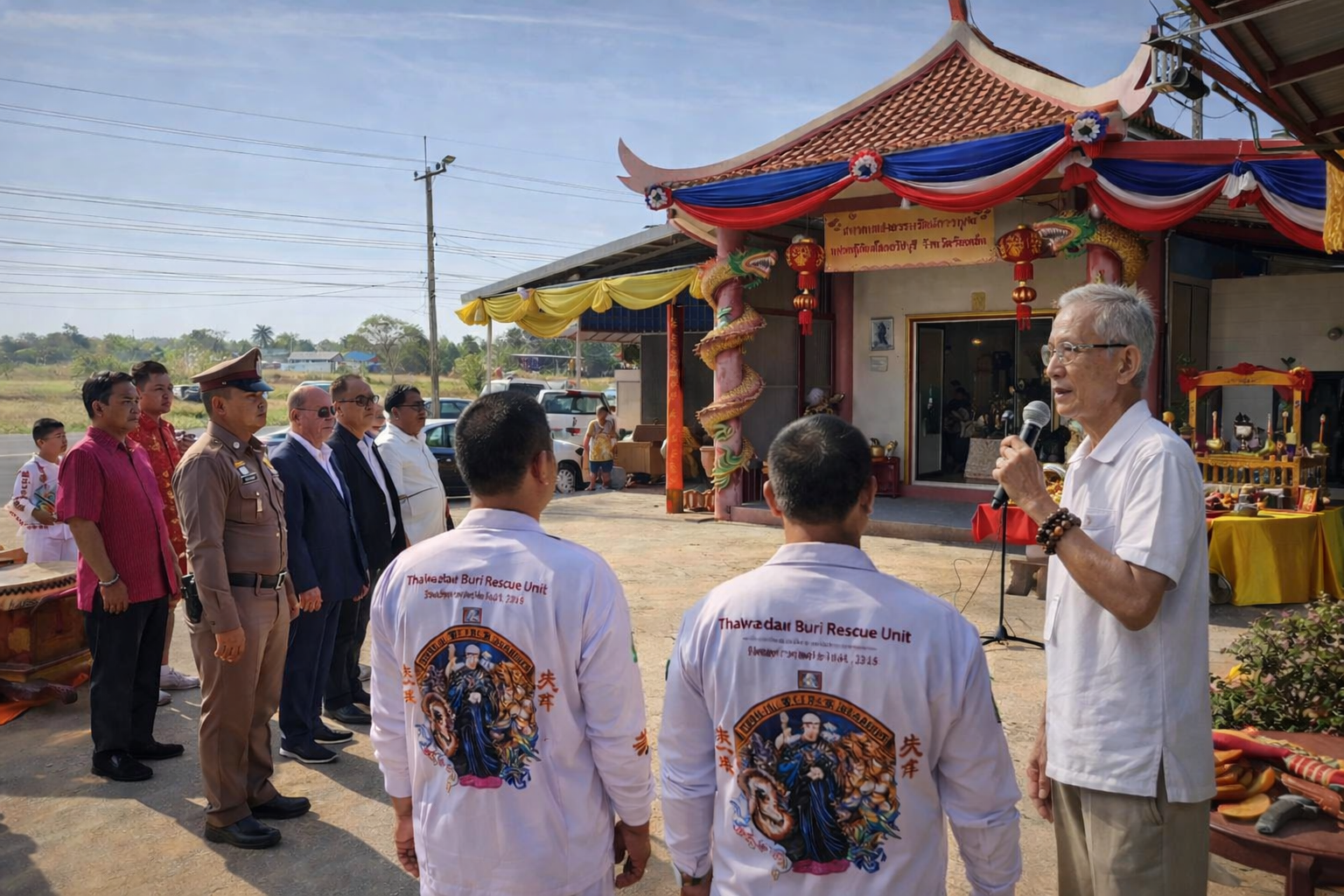
Yesterday, we celebrated Chinese New Year | เมื่อวานนี้ เราได้ร่วมเฉลิมฉลองเทศกาลตรุษจีน
Not in a big-city Chinatown, not as a tourist tableau, not as a “cultural event” with an announcer and a schedule. We celebrated it the way Thawat Buri celebrates things that matter: with people who do the work, with the temple as a living room, and with a quiet seriousness that doesn’t need to explain itself.
ไม่ใช่ในไชน่าทาวน์ของเมืองใหญ่ ไม่ใช่ฉากทัศน์สำหรับนักท่องเที่ยว และไม่ใช่ “กิจกรรมทางวัฒนธรรม” ที่มีโฆษกคอยกำหนดตารางการแสดง แต่เราฉลองในแบบที่ชาวธวัชบุรีฉลองให้กับสิ่งที่มีความหมาย นั่นคือการเฉลิมฉลองร่วมกับผู้คนที่ลงมือทำงานจริง โดยมีศาลเจ้าเป็นเหมือนห้องนั่งเล่น และเปี่ยมไปด้วยความจริงจังที่เรียบง่ายจนไม่ต้องมีคำอธิบายใดๆ
And—this is what I want to admit upfront—there was love in it.
และ—นี่คือสิ่งที่ผมอยากจะยอมรับตั้งแต่ต้น—มันมีความรักอยู่ในนั้น
Not the sentimental kind that tries to look good in public. A quieter one: the love of continuity, the love of elders who kept a tradition alive without ever calling it “heritage,” of a community that refuses to let life become purely transactional. You could feel that in the way people handled objects, in the patience with which they waited, in the attention paid to things that do not “increase efficiency” but do increase belonging.
ไม่ใช่ความรักแบบฟูมฟายที่พยายามทำให้ดูดีในสายตาประสาธารณชน แต่เป็นความรักที่เงียบสงบกว่านั้น: เป็นความรักในความต่อเนื่อง ความรักของเหล่าอาวุโสที่ธำรงไว้ซึ่งประเพณีโดยไม่เคยเรียกมันว่า “มรดก” และเป็นความรักของชุมชนที่ปฏิเสธจะปล่อยให้ชีวิตกลายเป็นเพียงเรื่องของผลประโยชน์ คุณสัมผัสได้จากวิธีที่ผู้คนหยิบจับสิ่งของ จากความอดทนในการรอคอย และจากความใส่ใจในสิ่งที่ไม่ได้รับรองว่าจะ “เพิ่มประสิทธิภาพ” แต่ช่วยเพิ่ม “ความรู้สึกเป็นส่วนหนึ่ง”
The Operating System of Isaan / ระบบปฏิบัติการแห่งอีสาน
The yearly ceremony took place at our local Chinese temple—yet what unfolded was not “Chinese” in a tidy, museum-like sense, and not “Buddhist” in the simplified postcard sense either. It was something I have learned to recognize as a normal state in Isaan: a layered coexistence of Thai Buddhism, older animist instincts about protection and place, and Chinese language and lineage—woven together so practically that calling it a “mixture” almost feels wrong. It is not a cocktail. It is an operating system.
พิธีกรรมประจำปีนี้จัดขึ้นที่ศาลเจ้าจีนในท้องถิ่นของเรา—ทว่าสิ่งที่เกิดขึ้นไม่ใช่ “ความเป็นจีน” ในแบบพิพิธภัณฑ์ที่จัดวางไว้อย่างเป็นระเบียบ และไม่ใช่ “ความเป็นพุทธ” ในแบบโปสการ์ดที่ถูกลดทอนรายละเอียด แต่มันคือสิ่งที่ผมได้เรียนรู้ที่จะจดจำในฐานะสภาวะปกติของ “อีสาน”: การดำรงอยู่ร่วมกันเป็นชั้นๆ ของพุทธศาสนาแบบไทย สัญชาตญาณความเชื่อแบบดั้งเดิมเกี่ยวกับการคุ้มครองและสถานที่ ตลอดจนภาษาและสายสัมพันธ์แบบจีน—ซึ่งถูกถักทอเข้าด้วยกันอย่างเป็นรูปธรรมจนการเรียกมันว่า “การผสมผสาน” ดูจะผิดเพี้ยนไปเสียหน่อย เพราะมันไม่ใช่ค็อกเทล แต่มันคือ “ระบบปฏิบัติการ”
And the organizers were not, as a Western mind might expect, a committee of devotees, or a cultural association, or a priestly body. The ceremony was organized by the local rescue unit—Thawatchaburi Rescue Unit—part of the Sangthammarat Charity Association in Roi Et.

และผู้จัดงานไม่ใช่คณะกรรมการผู้เลื่อมใส หรือสมาคมวัฒนธรรมอย่างที่ใจชาวตะวันตกอาจคาดหวัง แต่พิธีนี้จัดขึ้นโดยหน่วยกู้ภัยในพื้นที่—หน่วยกู้ภัยอโสกธวัชบุรี—ซึ่งเป็นส่วนหนึ่งของสมาคมแสงธรรมรัตน์การกุศล จังหวัดร้อยเอ็ด
Continuity Over Separation / ความต่อเนื่องเหนือการแบ่งแยก
Emergency services are state-owned, while religion is a private matter. Rituals are part of “belief,” and rescue is a matter of “competence.” In that worldview, you can respect tradition—but you keep it in its lane. Thawat Buri does not think in lanes. It thinks in continuity.
บริการฉุกเฉินเป็นของรัฐ ในขณะที่ศาสนาเป็นเรื่องส่วนบุคคล พิธีกรรมคือเรื่องของ “ความเชื่อ” ส่วนการกู้ภัยคือเรื่องของ “ความสามารถ” ในมุมมองโลกแบบนั้น คุณอาจจะเคารพประเพณีได้—แต่คุณต้องเก็บมันไว้ในเลนของมันเอง ทว่าชาวธวัชบุรีไม่ได้คิดแบบแบ่งเลน เราคิดแบบความต่อเนื่อง
Thailand has a phrase for a kind of death that is hard to digest—often translated as “bad death,” the kind that happens abruptly, violently, away from closure. In local belief, such deaths can leave behind a residue: not only psychological, but spiritual.
ประเทศไทยมีคำเรียกการตายที่ทำใจยอมรับได้ยาก—ซึ่งมักแปลว่า “ตายโหง” การตายที่เกิดขึ้นอย่างกะทันหัน รุนแรง และปราศจากการสั่งลา ในความเชื่อท้องถิ่น การตายเช่นนั้นสามารถหลงเหลือ “สิ่งตกค้าง” ไว้: ไม่ใช่แค่ทางจิตวิทยา แต่เป็นทางจิตวิญญาณ
Merit is not a Metaphor / บุญไม่ใช่คำอุปมา
In Thai practice, tam bun—making merit—is not only a private spirituality. It is a social mechanism for keeping the moral world from fraying. When you work close to injury and death, merit-making becomes a form of balance.
ในวิถีปฏิบัติของไทย การ “ทำบุญ” ไม่ใช่เพียงเรื่องจิตวิญญาณส่วนตัว แต่มันคือกลไกทางสังคมที่ช่วยไม่ให้โลกแห่งศีลธรรมเสื่อมสลาย เมื่อคุณทำงานใกล้ชิดกับอาการบาดเจ็บและความตาย การทำบุญจะกลายเป็นรูปแบบหนึ่งของการสร้างสมดุล
To treat the injured is medical. To treat the dead with dignity is also spiritual. To help families in shock is social. To “seal” the place of death—emotionally, morally, invisibly—is ritual. These are not separate functions; they are layers of the same response.
การรักษาผู้บาดเจ็บคือเรื่องทางการแพทย์ การจัดการกับร่างผู้เสียชีวิตด้วยศักดิ์ศรีคือเรื่องทางจิตวิญญาณ การช่วยเหลือครอบครัวที่อยู่ในอาการช็อกคือเรื่องทางสังคม การ “ปิด” สถานที่เกิดเหตุแห่งความตาย—ทั้งทางอารมณ์ ศีลธรรม และสิ่งที่มองไม่เห็น—คือพิธีกรรม สิ่งเหล่านี้ไม่ใช่หน้าที่ที่แยกจากกัน แต่มันคือชั้นต่างๆ ของการตอบสนองในเรื่องเดียวกัน
The Uniform as Spiritual Armor / เครื่องแบบในฐานะเกราะทางจิตวิญญาณ
On foundation shirts and imagery, you often find symbols like the Bagua, guardian animals, or lotus imagery. In the foundation’s own lived interpretation, such imagery acts as protection against malevolent forces and the unsettled residue associated with disaster scenes.

บนเสื้อและสัญลักษณ์ของมูลนิธิ คุณมักจะพบสัญลักษณ์ต่างๆ เช่น ยันต์แปดทิศ (ปากั้ว) สัตว์ผู้พิทักษ์ หรือรูปดอกบัว ในการตีความตามวิถีชีวิตของอาสาสมัคร สัญลักษณ์เหล่านี้ทำหน้าที่เป็นเครื่องป้องกันพลังงานที่ไม่ดี และสิ่งที่หลงเหลือจากเหตุการณ์สะเทือนขวัญ
Recognition as Love / การยอมรับคือรูปแบบหนึ่งของความรัก
Here in Roi Et – Thawat Buri, the lineage does not begin with an abstract idea. It begins with a named patriarch—He Ye Yun Sheng Zu—invoked as a living anchor of continuity for the rescue work.
ที่ร้อยเอ็ด-ธวัชบุรีแห่งนี้ สายสัมพันธ์ไม่ได้เริ่มต้นจากแนวคิดที่เป็นนามธรรม แต่มันเริ่มต้นจากพระวิสุทธิเทพบรรพบุรุษ—องค์เหอเยี่ยหยุนเซิ่งจู่ (He Ye Yun Sheng Zu)—ซึ่งถูกอัญเชิญมาเพื่อเป็นหลักยึดเหนี่ยวที่มีชีวิตของความต่อเนื่องในงานกู้ภัย
The Chinese layer—names, characters, ritual phrases—functions as a spine of belonging. It tells the wider community: this charity work, this rescue work, this moral seriousness did not appear out of nowhere. It grew from a tradition of mutual aid, protection, and duty.

ชั้นเชิงความเป็นจีน—ทั้งชื่อ ตัวอักษร และถ้อยคำในพิธีกรรม—ทำหน้าที่เป็นกระดูกสันหลังของความรู้สึกเป็นส่วนหนึ่ง มันบอกกับชุมชนในวงกว้างว่า: งานการกุศล งานกู้ภัย และความจริงจังทางศีลธรรมนี้ไม่ได้เกิดขึ้นมาจากความว่างเปล่า แต่มันเติบโตมาจากประเพณีของการช่วยเหลือซึ่งกันและกัน การคุ้มครอง และหน้าที่
My Role: The Ethics of Witnessing / บทบาทของผม: จริยธรรมของการเป็นพยาน
As a patron and honorary donor, I am involved with this organization in the position of Vice Chair of the Advisory Board, an honorary position. That matters, because it changes the ethics of witnessing. It asks for loyalty. And—again, I will use the word plainly—love.

Not love as blind approval. Love as fidelity to people who let you belong. Love as gratitude for being trusted with a role that is not symbolic. Love as the refusal to turn real lives into content.
So what I am offering here is not a definitive anthropological explanation, and not a spiritual manual. It is an attempt to describe a lived coherence that a Western lens often cannot see, because it is trained to divide.
In my life, I often describe what I call two lenses: the Western lens shaped by law, institutions, rational explanation; and the Isaan lens shaped by rural community life, where Buddhism and animist intuition are practical ways of relating to land, memory, and each other.
Chinese New Year at our temple is a perfect demonstration of why I need both lenses at once.
With the Western lens, I can recognize the rescue unit as a civic actor: a volunteer emergency service funded by donations, trusted by the public, providing a crucial function that sometimes fills gaps left by the state.
With the Isaan lens, I can recognize that trust is not built only through efficiency. It is built through moral resonance. People must feel that those who handle the dead do so with dignity; that those who enter traumatic sites do not bring back darkness; that the community’s unseen world is respected, not mocked.
And with the Thai-Chinese layer, I can see how lineage and symbols help carry that moral resonance across generations—less as ideology, more as continuity.
ผมมีส่วนร่วมกับหน่วยกู้ภัยนี้ในฐานะรองประธานที่ปรึกษา นั่นเป็นเรื่องสำคัญ เพราะมันเปลี่ยนจริยธรรมของการเป็นพยาน มันเรียกร้องความจงรักภักดี และ—ผมจะขอใช้คำนี้อย่างตรงไปตรงมาอีกครั้ง—ความรัก
ไม่ใช่ความรักแบบการยอมรับอย่างไม่ลืมหูลืมตา ความรักคือความซื่อสัตย์ต่อคนที่ให้คุณเป็นส่วนหนึ่ง ความรักคือความกตัญญูที่ได้รับความไว้วางใจให้รับบทบาทที่ไม่ใช่เชิงสัญลักษณ์ ความรักคือการปฏิเสธที่จะเปลี่ยนชีวิตจริงให้กลายเป็นเพียงเนื้อหาในสื่อต่างๆ
ดังนั้นสิ่งที่ฉันนำเสนอที่นี่ไม่ใช่คำอธิบายทางมานุษยวิทยาที่สมบูรณ์แบบ และไม่ใช่คู่มือทางจิตวิญญาณ แต่เป็นการพยายามอธิบายความสอดคล้องที่เกิดขึ้นจริง ซึ่งมุมมองแบบตะวันตกมักมองไม่เห็น เพราะถูกฝึกมาให้แบ่งแยก
ในชีวิตของฉัน ฉันมักอธิบายสิ่งที่ฉันเรียกว่าสองมุมมอง: มุมมองแบบตะวันตกที่ถูกหล่อหลอมด้วยกฎหมาย สถาบัน และคำอธิบายเชิงเหตุผล และมุมมองแบบอีสานที่ถูกหล่อหลอมด้วยชีวิตในชุมชนชนบท ที่ซึ่งพุทธศาสนาและสัญชาตญาณแบบอนิเมิสต์เป็นวิธีปฏิบัติในการเชื่อมโยงกับผืนดิน ความทรงจำ และผู้คนรอบข้าง
เทศกาลตรุษจีนที่วัดของเราเป็นตัวอย่างที่สมบูรณ์แบบว่าทำไมฉันจึงต้องการทั้งสองมุมมองพร้อมกัน
ด้วยมุมมองแบบตะวันตก ฉันสามารถมองเห็นหน่วยกู้ภัยในฐานะผู้มีบทบาทในสังคม: หน่วยบริการฉุกเฉินอาสาสมัครที่ได้รับเงินบริจาค ได้รับความไว้วางใจจากสาธารณชน และทำหน้าที่สำคัญที่บางครั้งช่วยเติมเต็มช่องว่างที่รัฐทิ้งไว้
ด้วยมุมมองแบบอีสาน ฉันจึงตระหนักได้ว่าความไว้วางใจไม่ได้สร้างขึ้นจากประสิทธิภาพเพียงอย่างเดียว แต่สร้างขึ้นจากคุณธรรม ผู้คนต้องรู้สึกว่าผู้ที่จัดการกับศพทำด้วยความเคารพศักดิ์ศรี ผู้ที่เข้าไปในสถานที่เกิดเหตุการณ์สะเทือนใจไม่ได้นำความมืดมนกลับมา และโลกที่มองไม่เห็นของชุมชนได้รับการเคารพ ไม่ใช่ถูกเยาะเย้ย
และด้วยมุมมองแบบไทย-จีน ฉันจึงเห็นว่าสายเลือดและสัญลักษณ์ช่วยส่งต่อคุณธรรมนั้นจากรุ่นสู่รุ่น ไม่ใช่ในฐานะอุดมการณ์ แต่ในฐานะความต่อเนื่อง
In Thawat Buri, saving lives and saving meaning are not two jobs. They are one.
ในธวัชบุรี การรักษาชีวิตและการรักษาความหมายไม่ใช่สองงานที่แยกจากกัน แต่มันคือสิ่งเดียวกัน
Used Terms / คำศัพท์ที่ใช้
- Isaan (อีสาน): Northeast Thailand. / ภาคตะวันออกเฉียงเหนือของประเทศไทย
- Tam bun (ทำบุญ): “Making merit”; doing good with intention as moral/spiritual cultivation. / การทำความดีด้วยเจตนาเพื่อขัดเกลาทางศีลธรรมและจิตวิญญาณ
- Bagua (ปากั้ว/แปดทิศ): Octagonal Taoist diagram used as a protective symbol. / แผนผังแปดทิศทางลัทธิเต๋า ใช้เป็นสัญลักษณ์ในการป้องกันและสร้างสมดุล
- Lineage (สายสัมพันธ์/ตระกูลธรรม): Continuity through founders and transmitted duty. / ความต่อเนื่องผ่านผู้ก่อตั้งและหน้าที่ที่สืบทอดกันมา
- Patriarch (บรรพบุรุษ/บูรพาจารย์): An anchor forebear figure honored as a source of continuity. / บุคคลต้นแบบหรือบรรพบุรุษที่ได้รับเกียรติในฐานะจุดเริ่มต้นของความต่อเนื่อง
- Syncretism (สังกร): The coexistence and blending of religious layers. / การดำรงอยู่ร่วมกันและการผสมผสานของชั้นเชิงทางศาสนาและวัฒนธรรม
- Rescue foundations (มูลนิธิกู้ภัย): Volunteer organizations providing emergency relief alongside spiritual traditions. / องค์กรอาสาสมัครที่ให้บริการบรรเทาสาธารณภัยควบคู่ไปกับประเพณีทางจิตวิญญาณ
The English Video
This piece first appeared on Substack. I republish it here voluntarily — not as repetition, but as trace; a place where words can rest after their first flight.
👉🏻 rftjon.substack.com
Full Version on 👇
อ่านฉบับเต็มได้ที่ 👇
https://open.substack.com/pub/rftjon/p/ed2?utm_campaign=post-expanded-share&utm_medium=web
© Robert F. Tjón, February 2026 | Creative Commons CC BY-NC-ND 4.0 International
