

Davos 2026, Carney vs. Trump, and the world that is learning to bargain again
It did not feel like a summit. It felt like a post-mortem.
Not because the world ended. But because a story ended: the story that we live inside a stable “rules-based international order,” held together by shared principles, predictable institutions, and a quiet belief that the arc of history bends toward cooperation if we just keep “the process” alive.
At Davos, the process was still there—speeches, panels, corridors, handshakes—but the shared belief was gone. The mood, as one analysis put it, was a collective acknowledgment that the old order is not merely under strain; it is being actively renegotiated.
And renegotiated is a polite word. A better one might be: re-priced.
Because the speeches were full of tariffs, leverage, strategic geography, and the “law of the strongest.” The question that hovered—like a cold draft in a warm room—was no longer “What is right?” but “What can you defend, and what will you trade?”
Two speakers crystallized this shift more sharply than most: Mark Carney and Donald Trump. Not because they were the only ones with power, but because they offered two different answers to the same brutal question:
When the rules no longer bind, what holds the world together?
This essay unfolds in three parts:
- the Carney–Trump confrontation,
- my own lens for reading it,
- three predictions—grounded, not prophetic—about where this seismic shift may lead.

Part I — The Trump–Carney confrontation
Two steering philosophies in a bargain-driven world
One way to understand Davos 2026 is this: the world is moving from rules to bargains.
That doesn’t mean international law vanishes. It means its universal enforcement power erodes, replaced by an order “defined by leverage: economic, strategic, technological, and geographic.”
If that sounds abstract, Davos made it concrete: it showed how quickly sovereignty itself becomes contested terrain—not in definition, but in application. In plain language: everyone says they respect borders; not everyone agrees on when borders can be bent.
1) Trump: Transactional Hegemony
Trump’s framing treated tariffs, deals, and strategic geography as the primary tools of statecraft. In this worldview, sovereignty is not a sacred absolute. It is something like a credit score: earned and defended through capability.
The Greenland episode became the symbol of this logic: territorial questions framed not as legal absolutes, but as negotiable strategic assets—with economic pressure as a legitimate instrument.
This is “Transactional Hegemony”: a world of bilateral deals mediated by American economic, energy and military strength. Alliances become negotiable arrangements tied to burden-sharing, trade balances, and geography.
The moral center of this model is not virtue. It is results—measured in output, bargaining wins, and visible advantage. It is a politics of “show me the deal.”
2) Carney: Value-Based Realism
Carney’s message begins from a different diagnosis: the transactional turn marks a rupture—the effective end of the rules-based order as it once functioned.
For him, the danger is not only great-power assertiveness, but the absence of organized resistance by middle powers. He argues that sovereignty and territorial integrity must remain non-negotiable baselines—or legitimacy collapses altogether.
Carney offers “Value-Based Realism”: variable geometry—a web of issue-specific coalitions and shifting partnerships. His version of sovereignty is “strategic autonomy”: not a slogan, but the material ability to “feed, fuel, and defend” your citizens.
He is not naïve. He is not promising a return to innocence. He is saying: if the world becomes a marketplace of coercion, then middle powers must either build capacity or be priced.
| Feature | Mark Carney: Value-Based Realism | Donald Trump: Transactional Hegemony |
| Worldview | Variable Geometry: The world is a web of issue-specific coalitions and shifting partnerships. | Unipolar Transactionalism: The world is a series of bilateral deals mediated by American economic and energy strength. |
| Sovereignty | Strategic Autonomy: True sovereignty is material—the ability of a middle power to “feed, fuel, and defend” its own citizens. | Territorial and Assertive: Sovereignty is about “America First,” protected borders, and the physical acquisition of strategic assets like Greenland. |
| Order vs. Rupture | Navigating the Rupture: Discards the “pleasant fiction” of the rules-based order to build resilient, value-driven structures. | Defying the Experts: Replaces traditional diplomatic “expert” models with a “miracle” of deregulation and tariff-driven results. |
| Energy & Tech | Investigative Stewardship: A $1 trillion investment in energy and AI transition as a foundation for national longevity. | Dominant Extraction: Rejects the “Green New Scam” in favor of “drilling, baby, drilling” and private power plants for AI giants. |
| The “Third Voice” | Leading from the Middle: Positions Canada as a leader of a “Third Path” for nations that refuse to be mere subordinates. | Leading from the Top: Positions the U.S. as the undisputed “engine of the planet” that others must follow or fall behind. |
3) The real collision: what sovereignty means when power returns
This is where the confrontation becomes more than personality. It becomes a fight over the definition of safety.
For Europe and Canada, sovereignty remains indivisible; territorial integrity is the bedrock of legitimacy, and any erosion sets precedents that weaken the entire system.
For Trump’s America, sovereignty is inseparable from security capability; strategic geography can override traditional red lines if national security is invoked. This logic does not deny sovereignty; it relativizes it.
And here is the phrase that should make every small and mid-sized country go quiet:
“Once sovereignty becomes conditional, no border is truly safe.”
In other words: the moment we normalize “pressure politics,” we don’t just change one dispute. We change the air everyone breathes.
4) Three visions, not one “West”
Davos 2026 also confirmed something many sensed but few said plainly: there is no longer a unified Western position, but three distinct visions of order—American, European, and Asian—each with different threat perceptions and priorities.
Trump’s American vision is instrumental: order is not a moral framework but a byproduct of successful deals.
Europe’s response, in the same analysis, has hardened: sovereignty and borders are foundational, strategic autonomy becomes a survival imperative, and principles without power are insufficient.
Asia’s positioning is more ambiguous, with China presenting itself as a defender of globalization while keeping sovereignty language abstract—benefiting from perceptions of Western incoherence.
The “Global South” voice, exemplified in that Davos snapshot by Indonesia, reframes sovereignty less as borders and more as resilience—food, energy, development security.
So the stage is not a simple duel. It is a world of diverging instincts—where even the meaning of “order” is up for negotiation.
Part II — Reading Davos
What we tolerate as normal, and what we are quietly training the future to accept
My own work circles around a deceptively simple question:
What do we tolerate as normal?
Not what we say we value. Not what we claim we defend. But what we let slide, what we excuse, what we call “realistic,” what we normalize because resisting would be costly.
That question becomes a mirror at Davos, because Davos is where the world’s elites rehearse what will later become public reality. If enough powerful people speak a language long enough—leverage, bargains, conditional sovereignty—it doesn’t stay language. It becomes infrastructure.
In my draft, the Carney–Trump confrontation is described as a stress test for legitimacy: Carney seeks legitimacy through stewardship and collective resilience; Trump seeks it through material results and transactional strength.
That is already a complete argument. But for me, it isn’t complete until it is grounded in lived experience—until it touches earth.
1) The bridge*: Western rationalism and Isaan realism
I live on a bridge.
Not a poetic bridge, though poetry helps. A real bridge between Western rationalism—systems, institutions, contracts, abstract universals—and a Southeast Asian lived experience where reality is often relational, local, embodied, and spiritual without being sentimental.
In a rice-field worldview, land is not only property. It is a companion. It has moods—drought, flood, fertility, exhaustion. It is tended, not merely extracted. And the act of tending builds something more durable than output: it builds responsibility.
Why does this matter for geopolitics?
Because the Greenland logic is the opposite: it treats land as a strategic object whose ownership can be negotiated if the buyer has enough leverage.
A world that adopts this logic is training itself to see territory—and therefore people—as variables in an optimization problem.
2) Integrative humanism: refusing the false choice
My “DNA” leans toward what I call integrative humanism: the refusal to accept the false choice between “principles without power” and “power without principles.”
Carney’s model risks becoming its own “pleasant fiction” if it cannot match the material output of superpowers. Trump’s model risks civilizational looting if it discards the ethical infrastructure of peace and cooperation.
That sentence matters because it refuses easy moral theater. It says: both models have shadows.
And it leads to the deeper question:
What kind of human being does each model train?
- A bargain-first world trains the negotiator, the winner, the enforcer.
- A value-anchored world trains the steward, the builder, the coalition-maker.
Neither is automatically good. Both can become dangerous when detached from humility and accountability.
3) Legitimacy as the scarce resource
In business, when a resource becomes scarce, its price rises.
In politics, legitimacy is becoming scarce.
In a bargain-driven world, legitimacy can no longer rely on shared myths. It has to be earned—either through visible delivery (Trump’s logic) or through credible stewardship that protects people and territory from coercion (Carney’s logic).
But here is the uncomfortable insight: both logics can erode legitimacy if they train cynicism.
- If everything is a deal, citizens learn that principles are for speeches, not for protection.
- If values are declared but not defended materially, citizens learn that values are decoration.
Davos 2026, in that sense, is not only geopolitics. It is pedagogy.
It teaches the world what to expect.
4) “Sovereignty is contested terrain” — and that changes us
*Dr. Jaganath Panda’s analysis says sovereignty has become contested terrain in application. This is not a technical note. It is existential.
Because when sovereignty becomes negotiable, people don’t just fear invasion. They fear abandonment—the sense that the powerful may decide your fate through bargains you did not sign.
And that fear has consequences. It produces radicalization, militarization, nationalism, and the kind of politics that says: if the world is a jungle, I will become a predator before I become prey.
That is how an “order” collapses without a single battle.
Part III — Three predictions
Not prophecies—three plausible paths through the next five years
Predictions should be humble. The world is not a chessboard; it is a weather system.
So I offer three predictions as three plausible trajectories—each already visible as a pattern at Davos 2026. The question is not which one will happen, but which one will dominate, and what choices might bend the curve.
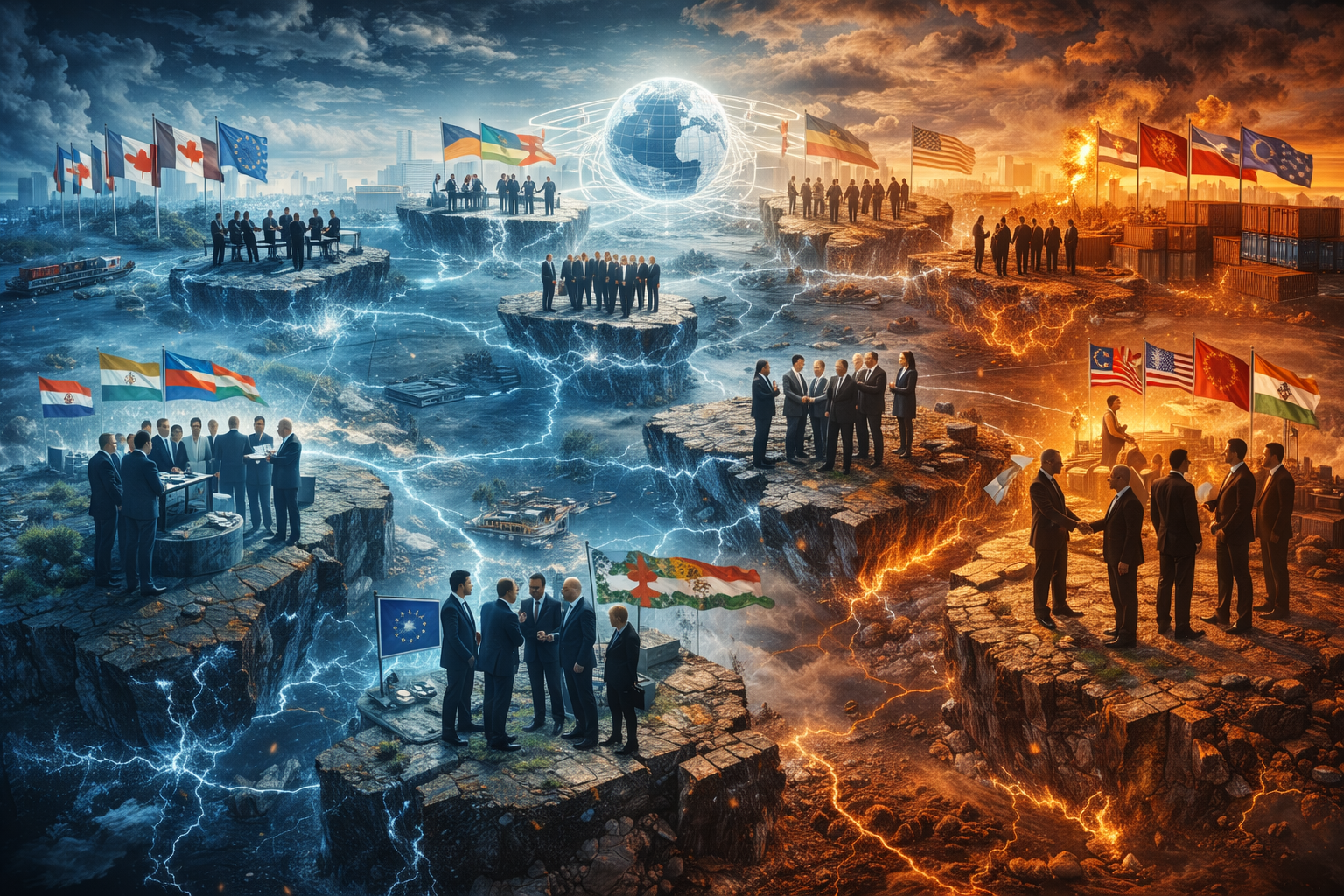
Prediction 1 — The Age of Archipelago Alliances
Fixed blocs weaken; shifting coalitions become normal.
If the world is moving from rules to bargains, the alliances built for a rules-based era will struggle. This does not mean alliances disappear. It means they become conditional, modular, and issue-specific.
Think of the world less as continents and more as an archipelago: islands connected by temporary bridges. Today the bridge is security. Tomorrow it is energy. The next day it is AI standards, supply chains, or shipping lanes.
This is already the conceptual terrain in the “variable geometry” idea: a web of issue-specific coalitions and shifting partnerships.
In such a world, the skill that matters most is not loyalty. It is translation:
- translating between American transactional demands and European legitimacy constraints,
- translating between Asian ambiguity and Western legalism,
- translating between “values” talk and “resilience” needs.
This is why the figure who wins is the “steward-translator”—the actor who can bridge transactional hegemony with value-based realism without becoming either a naïve moralist or a cynical broker.
Risk: The archipelago world can drift into permanent opportunism, where trust never accumulates long enough to solve long problems (climate, pandemics, debt).
Opportunity: Middle powers can gain leverage by becoming indispensable nodes—reliable on specific issues, even if non-aligned overall.
Prediction 2 — Parallel Nervous Systems
Money, energy, and technology split into competing stacks.
In a bargain-driven era, supply chains are not “efficient”; they are strategic. And strategic systems tend to duplicate.
The Diplomat framing suggests an order where norms persist but are continually tested; selective compliance becomes the default. Selective compliance is not only political; it becomes technical:
- standards diverge,
- payment rails fragment,
- energy security redefines trade.
This appears as the “bifurcation of money”—parallel financial nervous systems. Even if the exact labels evolve, the pattern is clear: countries and blocs build redundancy so they cannot be strangled by sanctions, embargoes, or tariff walls.
Add AI to this and the split accelerates: AI is hungry for compute; compute is hungry for energy; energy is back at the center of sovereignty. The “resilience” definition of sovereignty—food, energy, development security—becomes a baseline political demand.
Risk: Fragmentation raises costs, increases mistrust, and makes crises harder to coordinate.
Opportunity: Regions that can provide stable energy, stable governance, and credible neutrality become essential infrastructure for everyone.
Prediction 3 — The Stewardship Premium

Legitimacy becomes a competitive advantage—and “Ecority”* stops being poetic.
In a world where bargaining returns, the first casualties are usually the small, the weak, and the slow.
But the second-order effect is more surprising: people begin to prize trust again, because life inside permanent coercion is exhausting. Citizens, investors, and even governments start to pay a premium for jurisdictions that can credibly offer:
- predictable institutions,
- corruption control,
- resilient infrastructure,
- and a moral narrative that is backed by delivery.
This is the “stewardship premium”: the rise of actors who can defend principles materially—because, as the European argument goes, principles without power are insufficient.
It is also where Richard David Hames’ concept of Ecority* (ecology + integrity) stops being only a personal ethic and becomes a strategic posture: integrity is not softness; it is durability.
A bargain-driven world is tempted to strip-mine everything: resources, institutions, even truth. But strip-mining produces backlash, instability, and long-term brittleness. The winners of the next five years may be those who can combine:
- Carney’s insistence on non-negotiable baselines for legitimacy, with
- enough material capability to deter coercion, without
- adopting the worldview that makes every border conditional.
Risk: “Stewardship” becomes branding—a new pleasant fiction—if it cannot protect citizens from the hard edge of power.
Opportunity: Middle powers that build real resilience (food, energy, industrial capacity, social cohesion) become arbiters of legitimacy in a plural world.

Closing reflection: the question Davos didn’t answer
Davos 2026 clarified the stakes, even if it offered no new blueprint: we are entering an era where order exists, but “without illusions”—less universal, more contested, shaped by power as much as principle.
So the real question is not whether the world will bargain. It will.
The question is: What will we refuse to bargain away?
Because once a society—or a global system—starts treating sovereignty, dignity, and legitimacy as negotiable assets, it may win a few deals.
But it also trains a future in which trust becomes irrational, and fear becomes the only sensible policy.
And that is how a world order shifts: not with a single earthquake, but with a million small permissions.
Synthesis
- Davos 2026 signaled a shift from a rules-based order to a bargain-driven one, where leverage matters more and sovereignty becomes contested in practice.
- Trump embodies “transactional hegemony”: deals, tariffs, and strategic geography, treating sovereignty as conditional on capability.
- Carney embodies “value-based realism”: middle-power resistance, material resilience, and non-negotiable baselines for legitimacy.
- Through my lens (“what we tolerate as normal,” integrative humanism), the clash becomes a moral-psychological training ground for the future.
- Three plausible trajectories: archipelago alliances, parallel (split) systems, and a stewardship/legitimacy premium as a strategic advantage.
© Robert F. Tjón, January 2026
Creative Commons CC BY-NC-ND 4.0 International
Legend
- VBR: Value-Based Realism (Carney)
- TH: Transactional Hegemony (Trump)
- Variable geometry: flexible, issue-specific coalitions
- Ecority*: ecology + integrity
- WEF: World Economic Forum (context: Davos 2026)
Sources
- Transcript: Special Address by Donald J. Trump, Davos 2026 (https://www.weforum.org/stories/2026/01/davos-2026-special-address-donald-trump-president-united-states-america/)
- *After Davos 2026: Entering an Age of Contested Orders – The Diplomat, by Dr. Jaganath Panda (https://thediplomat.com/2026/01/after-davos-2026-entering-an-age-of-contested-orders/)
- *Understanding the World through different Lenses 👉🏻 https://open.substack.com/pub/rftjon/p/understanding-the-world-through-different?utm_campaign=post-expanded-share&utm_medium=web
- *On the Bridge between West and East* 👉🏻 https://open.substack.com/pub/rftjon/p/on-the-bridge-between-west-and-east?utm_campaign=post-expanded-share&utm_medium=web
- *Ecority: Transcending the Old Order, by Richard David Hames 👉🏻 https://open.substack.com/pub/richarddavidhames/p/transcending-the-old-order?utm_campaign=post-expanded-share&utm_medium=web
